Sunday, November 13, 2011

Peace Park, Atomic Bomb Museum, and Museum of Culture.

I delayed posting this subject to give myself time to really consider everything I heard that day and what I wanted to share. On Saturday November 5th we attended a day long educational event on the Atomic bomb beginning around 10am at Nagasaki University (not to be confused with my school). Our speaker for that morning was Joji Fukahori, he was in high school when the bomb was dropped on Nagasaki.

While I won't go into all the gory details he shared (though sadly he wasn't trying to be grisly, it really was just that bad after the impact) There are a few things I did want to share for his account. He is the sole survivor of his family (their house was 600 meters from the hypocenter). One of his younger brothers (age 11) died in the explosion (though it was from the pressure wave, not the fire). His little sister (age 5) died the next day from radiation poisoning, and while they had been in the same cemetery that night with other survivors seeking a place to just sit he never saw her before she passed away. His other brother (age 13) died a few weeks later from the damage done, both in infection (because there was nothing to use for sterilization because the hospitals were all wiped out, sadly this was mostly according to the US's plan) and radiation. The saddest part of this story though was the death of his mother. He described the scene in some detail, she was burned to death, but at the end he added a few words that broke my heart, he said, "I have not cried once since that day." Many people also died at the rivers desperately trying to get some water without knowing it was contaminated. I truly believe the Japanese are among a small number of people at points in history who can truly claim that what they saw was "hell on earth".
The atomic bomb detonated 1 km over Nagasaki on August 9th at 11:02am. Ground Zero was a few kilometers from the center of downtown, which was the original target. While not in place at the time, the Geneva Convention would later be amended to make such actions criminal. Since Nagasaki over 2,000 nuclear weapons have been tested in the atmosphere, in the ocean, and underground. The US accounts for over half of these tests, with nearly 1,000 occurring worldwide before underground tests became common practice, though this is apparently not presently true with China. I can not help but think that environmental changes and the rise in cancer are somehow directly related to these constant tests.
After the seminar we headed out to Nagasaki Peace Park, it was a rainy day and I was glad that I had photographed the park on a better day, please revisit my post about Nagasaki Peace Park if you would like to review the sculptures and monuments. One interesting fact that we heard during the tour from our guide was that there was a girl who was somewhere around 130 meters from the hypocenter when the bomb exploded, up on a hill, she was throw by the initial blast onto the other side of the mountain and miraculously survived, and is still alive today, though she does not live in Nagasaki, and is somewhat reclusive. All other information is in my previous post.
After our tour through the Peace Park we were allowed to wander the Atomic Bomb Museum. While I found it interesting I was a little disappointed that most of the exhibits showed the effects of a nuclear attack on various materials. One item that caught my attention (though for some reason I did not think to photograph it) was a wall clock that was mostly destroyed, but still shows the time of the attack. What was made this item of interest to me was that it was taken from Sakamoto Machi, I live in Sakamoto Machi. In truth my home is about 800 meters from ground zero, and I can imagine the view from this hill the day after the attack.

Some of the wreckage after the blast, twisted steel and stone rubble.
The area of affect. The orange ring is showing the expanses of the explosion, the blue circle is giving the rough area it covered. It honestly would have been worse if not for all the mountains here.


These are survivor stories, I hope you will take the time to read them.

The bomb
If you look closely you can see the shadow from a tree was "flashed" into the wood.
Various things exposed to the blast, see if you can figure out what they use to be.
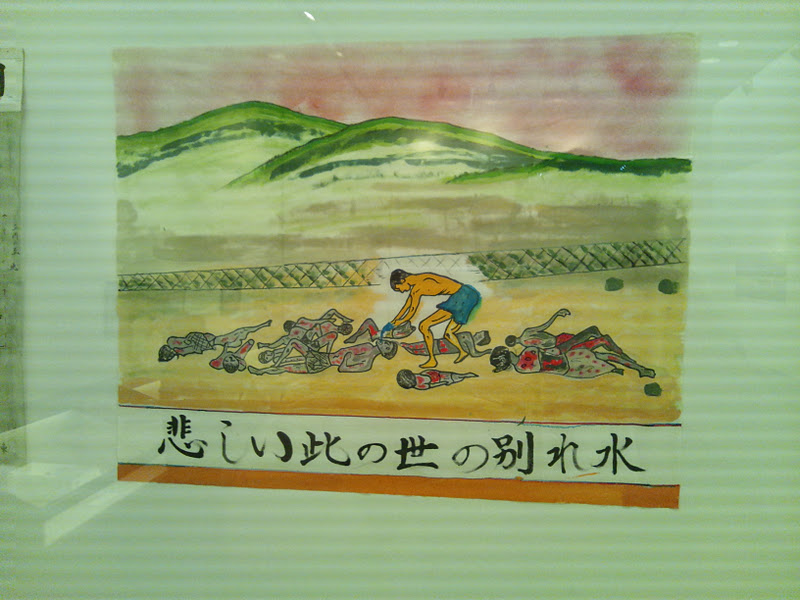

These paintings depict the aftermath in a less gruesome way.
Below are some works of art that I love. These pictures are made of little paper cranes. If you are unfamiliar with the legend, if you make 1,000 paper cranes you get a wish, these works of art are essentially filled with the prayers and wishes of the Japanese people for peace and a world without nuclear weapons.


 This is the Kanji for "Heiwa" it means "Peace"


After the atomic bomb museum our day was lightened up a little with a trip to the Nagasaki Museum of Culture. While I do not have much to say about the museum in general there were some interesting items that I saw, but I will allow you to look at the things I saw and get a feel for what Nagasaki was like during the period of isolation.


 See what they use to think Japan looked like?
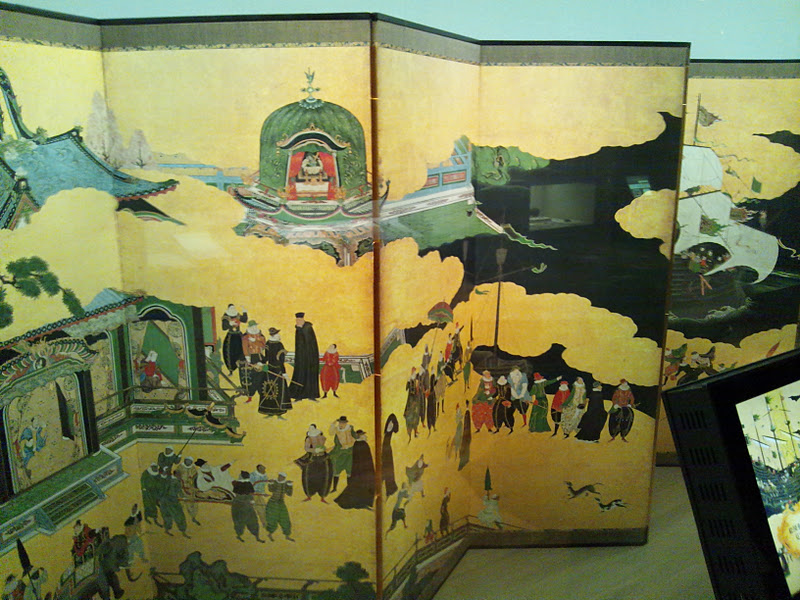

 Map of Nagasaki, fairly certain the red areas are where there were foreigners


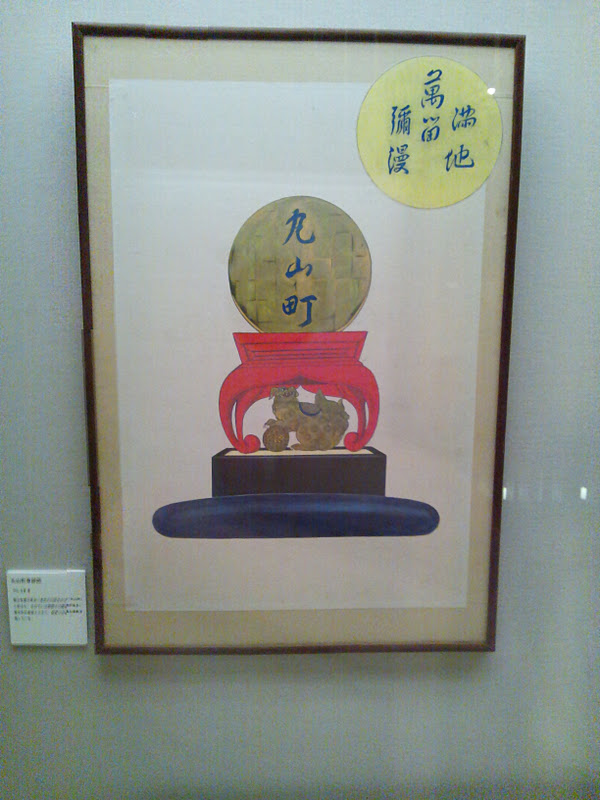
 Gate Pass

 The Chinese Temple in Nagasaki

 Same deity
 Chinese living quarter


 This huge pot was for cooking rice


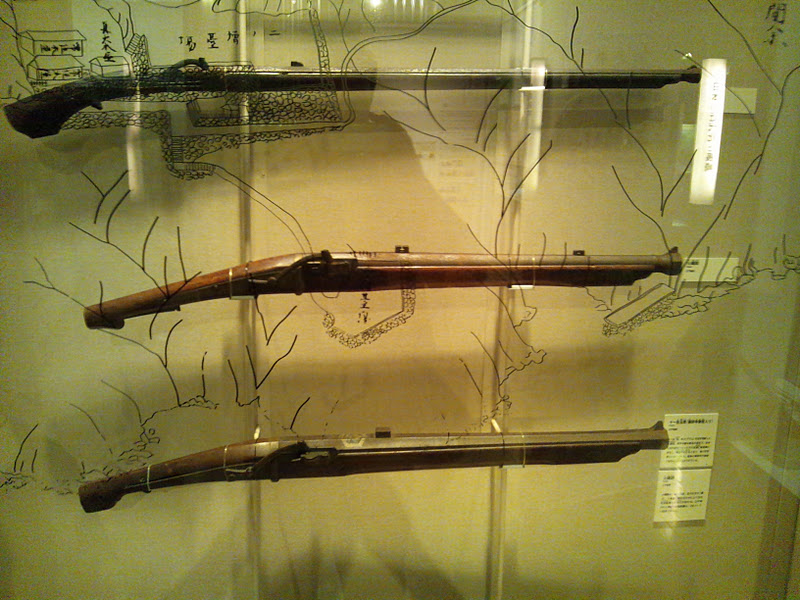
Leave it to me to find the swords
Below are a collection of Christian (Catholic) works from around the period it was banned
An early book on botany
There was more to see in this Museum, but for the day we were limited to the second floor. I plan to go back again when I have more time. This concludes my Saturday.

Thursday, November 3, 2011

Gai Go Sai

Last weekend we had Gai Go Sai, otherwise known as our school festival. Their was good food and a lot of entertainment. Some Chinese Student made some amazing Gyouza (pot stickers) and the Yakisoba was also particularly good. Though everything I ate was delicious having some Kangaroo was memorable, it tastes like deer if you were wondering, at the Australian booth. I also had Taiyaki with meat and curry in it, that was also really good, though in fairness so was everything I ate, the mentioned items just have the distinction of being memorable for either rarity or a new twist on flavor. The only down side was that it rained all weekend. For a country where the rainy season is supposed to be over it sure does rain a lot.

 Koto, you've probably heard these in oriental music and not realized it.
 There were many live band performances by local groups, but they were too loud for me to get video. 

 "Mama mia, do you like scary movies?"


Rather than explain all the things I saw it's just easier to show you. Below are some videos of traditional Japanese dance, including one with several of my classmates, and more modern dance groups. The last batch are from a fashion show that was put on Sunday evening (I apologize for the lighting).

And now Street Dancing!
(Some may not have audio since Youtube has issues with copyrighted music)

And the world of Japanese Fashion!
No I did not skip one I simply mislabeled them...

The finale!

Also there was a fire Friday morning somewhere near where I live. What was interesting was that the city seems to have a PA system over which they announce everything. Now after the warning siren, the announcement began with "Kochira", which means "over here" or "this way", but it honestly sounded like they said "Gojira" which is "Godzilla", so I was thinking something more like this:
So I got to have my moment where I imagined Godzilla had shown up in Nagasaki harbor and we all had to flee to the shelters as the JSDF tried to stop him. I'm not sure what happened with the fire, I never heard anything about it though, so I assume it was nothing serious, it may have just been a grass fire. Anyway that was the school festival, this coming weekend we are attending a lecture on the aftermath of the atomic bomb and will be touring the Atomic Bomb Museum along with the Nagasaki Museum of Natural History.

Wednesday, November 2, 2011

Yen: Bane of my finances

When I first came to Japan I thought that this little beast would be my downfall:
However, I have discovered since I have been here that it is not this 500 yen coin (scale is about right to the rest of the coins below) that is roughly the size of a quarter that dooms my finances so often. Allow me to show you the line up and you can try and guess. First the other coins:
From Left to Right: 1, 5, 10, 50, 100 yen
And now the bills:
From Top to Bottom: 1,000, 2,000, 5,000, 10,000 yen
There is one coin and one bill that are the bane of my existence. Can you guess? I can tell you it's not the 2,000 yen bill, in fact I have not even seen one of these since I spent my last one. They just aren't used around here as near as I can tell. So the fiends that cause me to spend the most money randomly are the 100 yen coin, which is worth about $1.30 and is about the size of a nickle, it is so easy to just toss these into machines and get a drink. The other difficult one is the 1,000 yen bill. It is the lowest denomination bill and is therefore associated in my mind with $1 even though it is worth $13. I do not tend to carry many of the 5,000 and 10,000 yen bills because there are many places you can not use them easily, so I tend to break them as quickly as possible. My other problem is that with a budget of $100 a week I tend to think that it equates to 10,000 yen a week, wrong. This has caused me to spend almost 1,000 yen a day for food and some weeks spend almost 4,000 yen on fun, not to mention the roughly 2,000 yen a week I need for transportation. Out of everything in Japan I have adjusted to the value of the yen the slowest, making it one of the most difficult things I have had to deal with. When you grew up in a society where your first bill is the dollar and everything else is coins and then come to a society where the first bill is closer to ten dollars and the rest is in coins I am truly amazed I have not been spending more than two or three times more than I should in a given week. However, this is something I have to remind myself of every time I open my wallet.